
Hermann Gustav Thiel (1878 – 1948) was the only member of the Thiel family to take an active part in the Anglo-Boer War (1899 – 1902). He became a member of the State Artillery of the Zuid Afrikaansche Republiek. He kept diaries of his experiences and observations during the war in the Transvaal, the voyage to Bermuda and his stay on several of the islands in the Bermuda archipelago. Towards the end of his active service he personally destroyed the last of the four Long Tom Guns of the Boer forces to prevent it falling into the hands of the enemy soldiers. Shortly thereafter he was captured and sent as a Prisoner of War to the Bermuda Islands. We intend to report on the highlights of his participation in the Anglo-Boer War and his memorabilia on this website.
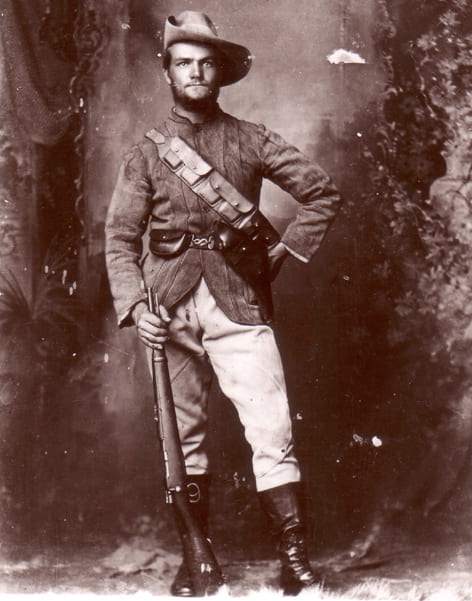
Hermann Thiel in the uniform of a member of the State Artillery of the Zuid Afrikaansche Republiek.
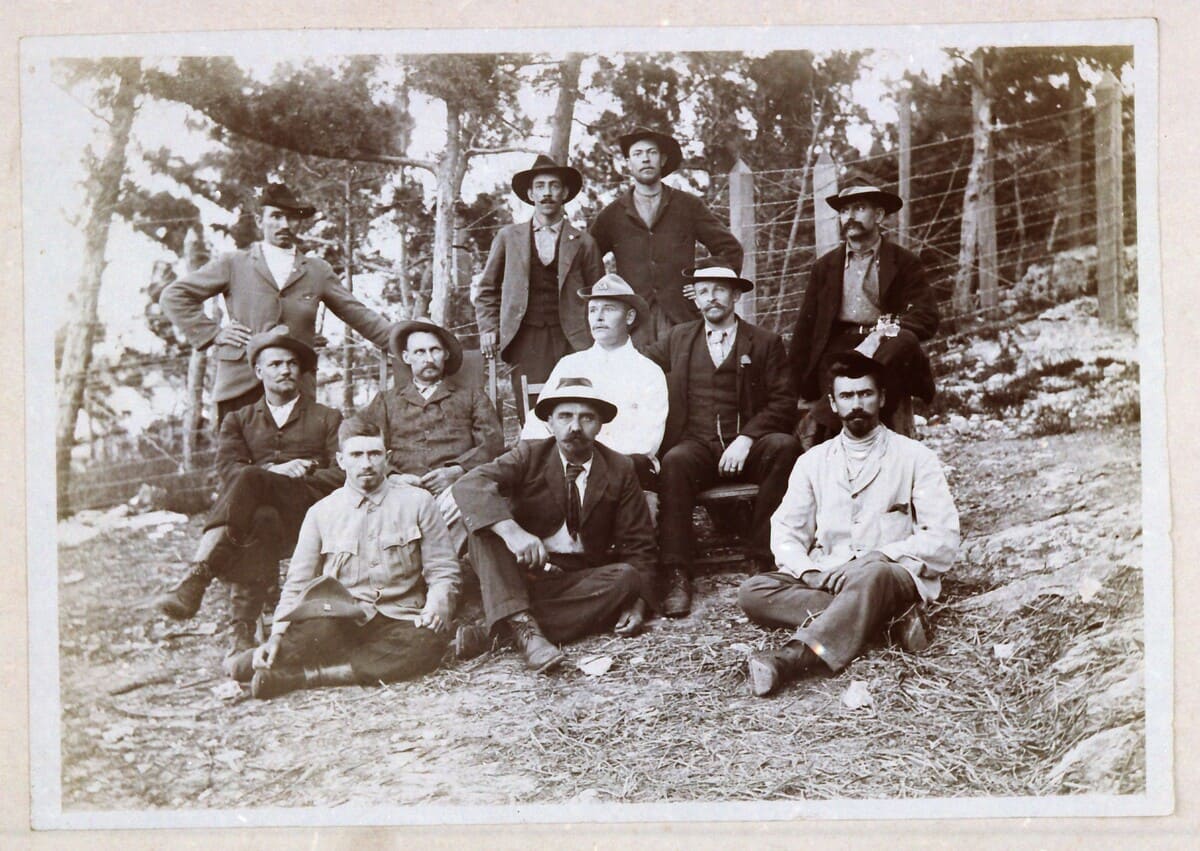
Hermann Thiel on the left in the middle row with
fellow Boer prisoners of war on Burtts Island, Bermuda.
On 8 May 1902 on Burtts Island in the Bermudas he decided to write a description of A Day in the life of a Boer Prisoner of War on the Bermuda Islands during the Anglo Boer War (1899 – 1902). The title of his text was Twenty-four hours in a Prisoner of War Camp (24 Uuren in een Krijgsgevangenen Kamp). He included this text as a small part of the memorial album about his time as a POW, dedicated to his young wife in the Transvaal republic.
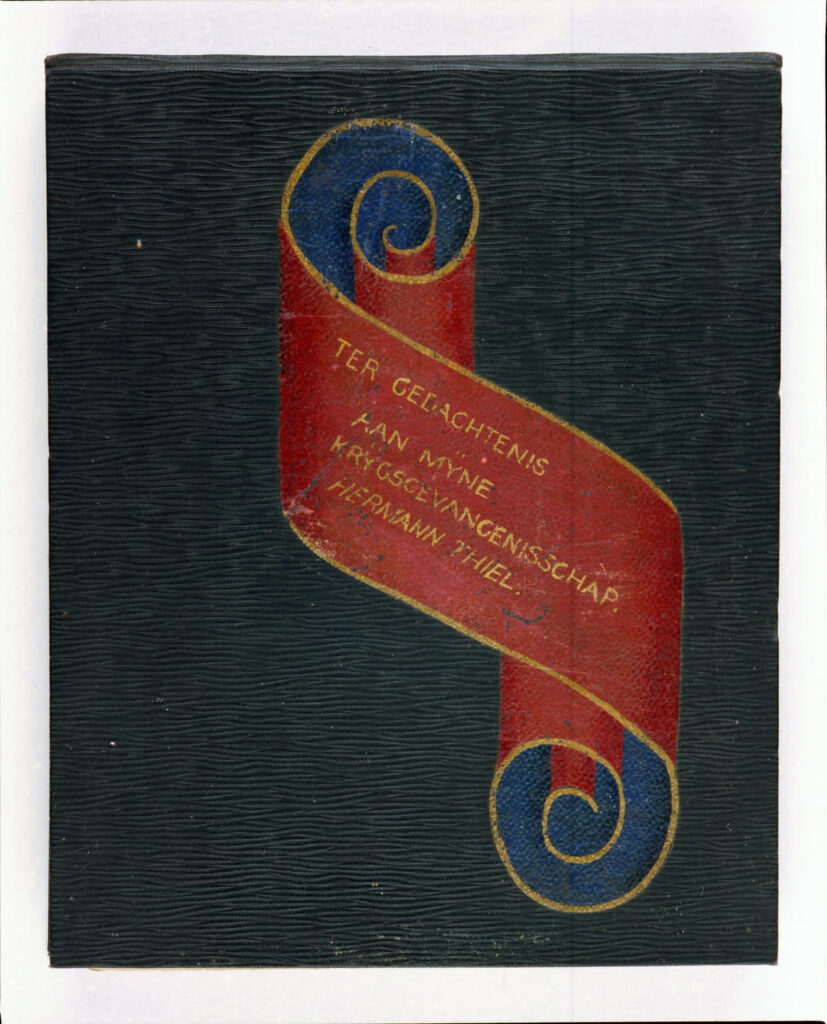
Cover of the Memorial Album
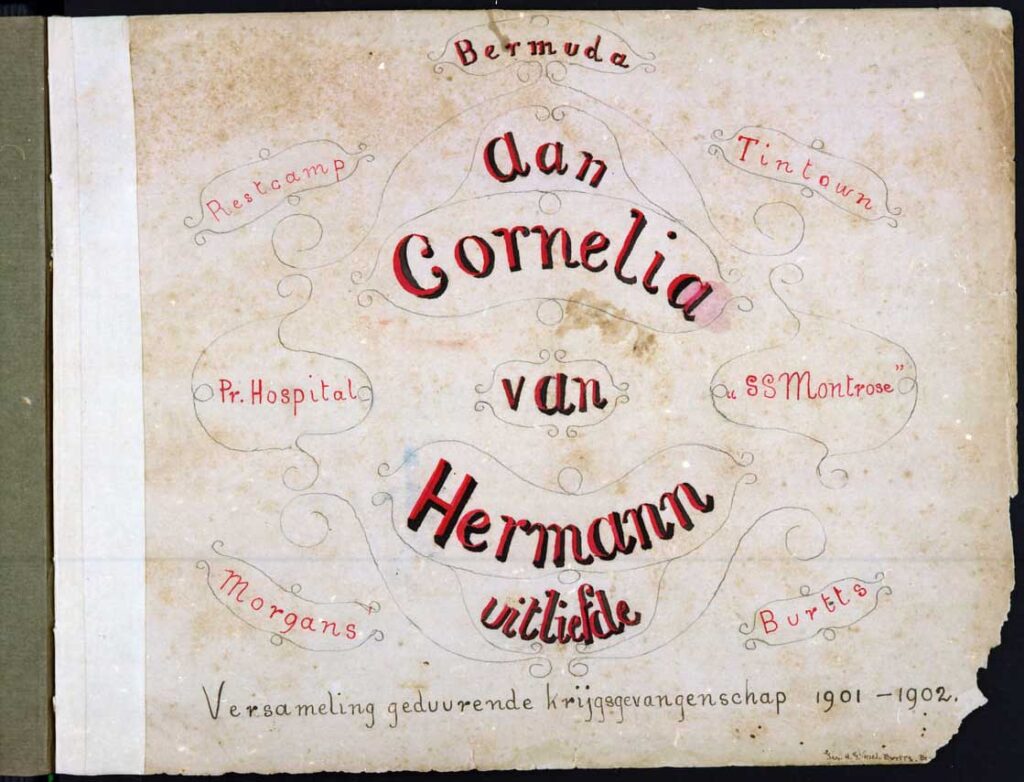
Dedication of the Album to Cornelia Thiel
textHe brought the memorial album along to Pretoria after the war had ended, and it remained in his possession when he assumed the position of resident engineer at the Messina Copper Mine in 1910 and when he moved to Tanganyika (now Tanzania) in 1923.
When he passed away in Lushoto in Tanganyika on 15 November 1948, the album went to his daughter, Cornelia Pauline Philomine Thiel, who lived in the coastal town of Tanga. Cornelia brought it back to South Africa in 1960 and when she passed away in Pretoria in 1982 it went to her brother (my father), Hermann Paul Emil Thiel in Potchefstroom. After my father’s death in 1992 it came into my possession, and I included it in The P.G. Thiel Collection which is maintained at my home in Stellenbosch.
The album is a remarkable document, containing correspondence which my grandfather conducted with the British commander on Bermuda on behalf of the Boers under his command, poems by himself and by his fellow prisoner of war, Joubert Reitz, a detailed map he drew of the Bermuda islands, drawings and photographs depicting life of the prisoners of war on the islands, as well as several stamped envelopes and letters he received from the Transvaal, the Netherlands and Germany.
In addition to the album, Hermann Thiel also kept a detailed diary in four notebooks of his experiences and observations during the War in the Transvaal, the voyage to Bermuda and his stay on several of the islands in the Bermuda archipelago.
On 29 April 1903 Hermann Thiel sent a copy of the text of Twenty-four hours in a Prisoner of War Camp in his neat handwriting to the South African historian, Gustav Preller, who solicited contributions about the war from the public for inclusion in a book he intended publishing. The book was never published, but the text ended up in the Preller Collection in the Transvaal Archives in Pretoria. With minor exceptions, this copy is an exact replica of the original text in the private album and written in Bermuda on 8 May 1902. The original text was written in Dutch and was published in annotated form by J.C. Pretorius, O.J.O. Ferreira and P.G. Thiel in the South African Journal of Cultural History Vol. 10, p 87 (1996).
To make the text of Twenty-four hours in a Prisoner of War Camp more widely available, I translated the text into English for publication in The Anglo Boer-War Philatelist with short introductory notes and selected illustrative material about Hermann Gustav Thiel and from his memorial album.
This English translation was published in The Anglo-Boer War Philatelist Volume 53, Number 1, March 2010 under the title:
A DAY IN THE LIFE OF A BOER PRISONER OF WAR IN BERMUDA IN 1902
HERMANN GUSTAV THIEL (1878 – 1948)
With Introduction and Comments by Pieter Gustav Thiel
(English translation of the document)
It is night! A beautiful, clear, tropical night wonderfully lit by a full moon. The deep quiet is disturbed only by the soft rustling of the branches and leaves of the sparse cedar trees and the gentle waves of the ocean breaking on the rocky beach. At this moment the small Morgans Island is home to 800 Boer Prisoners of War, separated by four rows of intertwined barbed wire from their guards, approximately 50 Khakis. On the one side the armed Brit; on the other side the captured Boer.
Everything is quiet! Everything is asleep. Everything is peaceful. An outsider could have thought that no living person was awake, but no, not everybody is asleep. Three creatures are moving like ghosts along the fence. They are the guards! Are they guards of honour? Are they placed there for the safety of the Boers? No – their vigilance has another purpose. There might be individuals amongst these freedom-loving Boers who, like a caged bird, unable to suppress the longing, might try to escape, defying many dangers. This is the purpose for which the guards have been posted. Should someone try to grab his freedom, a bullet would soon bring him death and doom.
Everything is sunk in deep rest: suddenly the silence is broken. One hears twelve strokes on the triangle. A wonderfully clear, ringing sound. It is midnight. Guard No. 1 calls out loudly and somewhat formally, “Number one and All’s Well!!!!!” Guard No. 2 proceeds with, “Number two and all’s well” and Guard No. 3 follows with, “Number three and all’s well.” Then everything returns to peace and quiet. So the night passes, with the rest only broken every quarter of an hour by the loud calls of the guards, “All’s well”. Before daybreak, at around 4 am, some of the older Boers get up according to an old tradition in their country (“early to bed and early to rise”). After a brief religious exercise consisting of a Psalm or Hymn and a prayer, they dress themselves and carry their pots filled with water to the fireplace to brew their morning coffee. There are not many of them and the night’s rest is not disturbed too much. It is in fact against the rules to wander around before the blowing of “Reveille”, but the old Boers are incapable of breaking their habits, and before the break of day they have to have their cup of coffee.
The Day begins. Five strokes on the Triangle, the call of “All’s well”, and the bugle announces daybreak with a resounding noise. The “Reveille Call” is a beautiful melody, but as most of the prisoners are disturbed in their sweetest sleep, they greet the call with many angry mutterings and even curses. Even the bugler is confronted with abuse. Reveille is the signal for rising but as it is not strictly enforced, those who still want to sleep turn around for another hour of slumber. Those who are on cook’s duty (approximately 100 men from the camp) get up and proceed to the fireplace. They prepare the pots for breakfast. The noise in the camp is increasing and, whereas all was peaceful an hour ago, active life has now started.
6.00 am.
The trumpet blows “Roll Call”. Everyone must obey this summons. The call consists of three dull, discordant and random notes. On Morgans Island there is fortunately a level, spacious area suitable for use by the prisoners of war for recreational purposes. This area used to be a potato garden on this rocky island. Here all the burghers must now assemble according to their rows, numbered from A to K (I and J excluded). Every row, two abreast, with approximately 90 men. Each Line Captain checks his line and counts his burghers; then an English Captain or Lieutenant arrives with a sergeant to count each line individually. No absentees are allowed, on pain of punishment. Those who are unable to attend due to illness or other reasons, have to go to the hospital tent and wait there. Each day one of the 9 Lines with their Line Captain is on duty for cleaning the camp, carrying rations etc. During the count, the Line Captain has already informed his 36 burghers about the duties they have to perform that day. The count lasts ten minutes, and fortunately everyone is present, except one late sleeper who is chastised by the Lieutenant. The trumpet sounds “fall out”, a single woeful sound of only one note.
Twelve of the burghers on duty accompany their Captain to the gate, enter together with the Boer Quartermaster and go to the Pier, followed by two guards, to offload bread, meat, vegetables, coffee and sugar from the steamboat or tug (duty boat); they carry everything to a big Marquee tent in the Boer camp, the Commissariat. This concludes their duties for the morning. Immediately after Roll Call, the Boer Camp Secretary walks to the gate where the burghers assembled to work for the English for a sum of 1/- per day on a water reservoir recently begun. Each line works for a day in rotation. After the 50 men have assembled and answered to their names, they march over to the hole. Ten of them enter through the gate and fetch all the necessary tools, such as wheelbarrows, spades etc. After “Roll Call” approximately 150 men remain in the recreation area and take part in morning prayers.
7.00 am.
Load strokes are heard on the triangle at the Commissariat, a sign for the distribution of bread, coffee and sugar. Every Tent Corporal collects his tins and bread bag and proceeds to the Marquee tent where he receives 8 ¼ lb bread, 12 oz sugar and two and two thirds’ ounces of coffee. [The distribution proceeds according to line and tent numbers and everything is weighed out meticulously by the Commissariat (10 Boers)]. This distribution lasts about half an hour which may be regarded as very fast. Many of the men now have their morning bath in the wonderful ocean while others are fishing. The distribution of water coincides with the distribution of rations. A pump has been installed which pumps locally distilled seawater from the water tanks. A Khaki is present and distributes one bucket of water to every tent for breakfast. The pumping is of course done by the burghers themselves.
8.00 am.
This is breakfast time, but it does not happen punctually, as each tent with 7 men provides for itself and each tent Corporal organizes breakfast individually. The Line Captain on duty is responsible for the whole camp and must assign all the tasks for the day. This is the day for scrubbing floors, and the Line Captain on duty orders the other Captains to remove and scrub all the tent floors, have all tents neatly rolled up and sweep the whole area clean.
Half past eight on the triangle.
The captain on duty assembles his 24 burghers at the gate for camp cleaning. The men fall in and are assigned to different duties. Four of them proceed with a Burgher Corporal to the cooking stations where they have to clean everything, sweep the area and whitewash the fireplaces. Ten men proceed with an English Sergeant to clean and sweep the whole camp, picking up papers and rinds and loading the rubbish heaps between the tents on wheelbarrows; all the paths are also cleaned and the stone walls bordering the paths are repaired. Ten men proceed with an English Corporal to rinse all the water storage areas, toilets and washing houses with seawater, for which hand pumps have been installed for their convenience. The cleaning of the camp takes approximately one and a half hours.
10.00 am.
The schools, where teaching is done by the burghers in Dutch, start now and the younger ones and children hurry not to be late. There is a court case due about a contravention of the Camp Regulations, and the court session commences. The Magistrate (Landdrost) and Assessors (Heemrade) are appointed by the Burgher Commandant. The legal agents present their arguments very well, and one could almost imagine oneself in the Magistrate’s Court in Pretoria. The accused is sentenced to a 5/- fine or 8 days camp service under supervision of the Line Captain. The fine is paid. The money is used at the end of the month to buy tobacco for distribution amongst the men. Yes, everywhere the Prisoners of War are busy. There is a lot of hustle and bustle but each one knows his business. Those who are not on duty are crafting all kinds of articles from wood, tin, stone, slate, bone, leather, yes from any material from which anything can possibly be produced. The most beautiful small tables, sewing boxes, picture frames, broaches, walking sticks, rings, suitcases, containers etc., etc. are being produced. Everyone is busy, not a single loafer. Here is the shop where two Boers are hurrying about behind the counter selling tobacco, matches, flour for pancakes, minerals, postage stamps, writing paper, tools of all kinds, food items, yes a thousand different items. Back at the Commissariat 10 burghers are weighing out and distributing meat from large hindquarters. The triangle strikes again, and the rations for the midday meal are now distributed. Each Tent Corporal approaches with his meat dish and vegetable bucket and receives, as before, line for line, 6 lb meat, 2 ½ lb vegetables, pepper and salt. Water is distributed at the same time, but now two buckets per tent. Somewhat further you can hear the whirring of several wood lathes (self-made), the hammering of the cabinet makers and the sawing of the blocks of timber which were recovered from the sea, washed up on the beach by a storm. Over there is the large water reservoir where the 50 burghers are working under the supervision of a Burgher Corporal. It is clear, however, that the pay is poor, as several are sitting or even lying down to take a nap. One shilling (1/-) per day is not a good incentive for work. Some of the men are playing Cricket or Football on the parade ground.
10.30 am
Inspection time is approaching. All the tent floors are replaced and all the beds and trunks are neatly stacked. All the eating utensils are laid out.
11.00 am
Inspection time and doctor’s inspection. The Line Captain on duty walks down to the gate and awaits the arrival of the English Camp Commandant (Major Elkington). The major arrives with the naphtha boat from headquarters on Tucker’s Island and inspects the whole camp with the Line Captain. The major expresses his satisfaction with the camp and departs after exchanging a few words with the Burgher Commandant (Commandant van Deventer). At the same time the English doctor arrives at the hospital tent where all the sick burghers are assembled. Here medicine is distributed, and it is a comical sight. One complains about his stomach. “My stomach is not working. It is already 7 days since it last worked.” “O, give him three number nine pills. That will work him.” It seems as if the English doctors “fix” everything with either number nine pills or quinine. Two burghers are seriously ill and have to go to the hospital on Portts Island. The sailboat has arrived at the pier, and the Line Captain with 12 burghers empty the trash cans into it. This does not take long, and all the tasks are nearly done. The fireplaces are covered with pots with food for the midday meal, and it is quite an amusing picture. Two burghers are quarrelling because one has stolen the other’s cooking spot or his fire. The Line Captain appears and soon restores order. This cooking site is the Office for the Pancake News. This is where all the official war stories originate, most probably hatched from the pots. The Cafes and Billiard tents are not yet very busy – it will be better in the afternoon.
12 noon
Mealtime. The triangle strikes 12, and they hoist the time ball on the Bermuda lighthouse (Gibbs Hill). It is mealtime and everyone goes to his own tent. The majority will be eating on self-made tables under the trees protected from the burning sun by bed covers or some other material. It is cooler to eat outside and, moreover, the tent floors remain clean. “How tough this meat is.” “You have stolen my potato.” “We must play a trick on the cook, he forgot the salt.” etc., etc. These remarks keep everybody laughing during the meal. This does not last long since everyone has only one piece of meat, one or two potatoes and bread with black coffee. Afterwards some lie down to sleep, others collect water for the tents, again one bucket per tent. The Billiard Tent is getting busy and you can hear the balls clicking. “All assemble !!!. All assemble !!! At the tent of the Commandant.” Everybody rushes over. Would it be news of peace?? Would he instruct the burghers to prepare themselves?? These are the thoughts of a few old burghers who have been sitting on the rocks for hours watching to see whether the ship which will liberate them is not perhaps approaching. All assemble around the Commandant. “Good day Burghers!” “Good day Commandant.” “Burghers, I have assembled you here to inform you that the major has reported that he is very dissatisfied with the bad habits of some burghers who refuse to listen and who keep throwing refuse and dirty water everywhere. He says the camp is not nearly as clean as in the beginning. We must not let our good name suffer, and I trust everybody will take good care in future. I do not wish to hear this again. I warn all Corporals that if it happens again, I will punish them severely. I have spoken.”
The burghers return. You can hear them mumbling. One old man says, “I thought he wanted to tell us we can go home and now it ended up with this nonsense.”
3.00 pm
A boat with American ladies passes by close to the water’s edge. The workers in the water hole see them first. One minute later the whole camp knows about it. The men stream to the waterfront, many hurry along and seem tobe enjoying themselves. The ladies wave their handkerchiefs and the burghers wave back. One tries to be smarter than the others and some strike ridiculous poses. One lady has a camera, clicks and a picture is taken. One young girl holds an American flag aloft. A chorus of hurrahs is the answer of the Boers. “Man, it is so nice to see a young girl again, I have sorely missed their company.” “When we go back, I will kiss all the girls who come to the railway stations. I would not mind it even if they are terribly ugly.” Etc., etc. These are the conversations amongst the men.
4.00 pm
“Roll Call”. The trumpet again produces its lament, and everybody proceeds to the recreation area. Everybody is present and the trumpet sounds dismiss and brays Baaaaah!!! Letters!!! Letters!!!
Letters received!!!! A wonderfully happy call which penetrates to the very heart. The mail has just arrived. The Secretary brought it from Tuckers Island shortly before Roll Call. There are about 200 letters, and the Postmaster calls them out one by one. One person is fortunate enough to receive several letters which he opens. His news is good. A broad smile spreads over his face. Another has never received a letter since he arrived here and listens with only half an ear. He says, “I will not receive anything.” His name is called out loudly. A joyful expression lights up his face. A happy shout comes from his lips and he grabs the letter. He tears it open. He reads, but o God, what is that? His dear wife and three children, from whom he has not heard a word since he departed on Commando two years ago, are all dead. The deprivation and neglect in the Concentration Camps had caused their death. It is a letter from his mother. Tears fill his eyes. He leaves the group and moves away, sobbing.
After Roll Call several partake in prayers, but because of the arrival of mail the proceedings are shortened. After half an hour all letters have been read. The men go to their tents, amble around, or go swimming. The Artillery Officer (Adjutant) calls his volunteers together and leads them in platoon marching practice. They are making excellent progress and should be good recruits for the State Artillery. Others are preparing supper which consists of dry, sour bread and black coffee.
6.00 pm.
The trumpet sounds. The sun sets and set he must whether he wants to or not. The debating society and the bible class assemble and in a third tent the religious Youth Society meet. The church choir is practicing. The Billiard saloon and Cafes are still being frequented. There is music (harmonica, flute, guitar and mandolin) and it is all very merry. You can enjoy coffee or tea or cocoa with cake (Bermuda Pudding, German Bun or Tart) baked by our own chef. The children are playing games outside, such as Hide and Seek, Marbles or Spinning a Top. Everybody is amusing himself the best he can. Many are wandering around enjoying the lovely moonlit evening. Others are reading in their tents.
8.30 pm.
The trumpet sounds “Last Post” and all are supposed to return to their tents, but this rule is not strictly observed. A group of burghers gathered together to sing national songs, while inspirational speeches are made here and there. In many tents evening prayers are held, accompanied by the singing of psalms and hymns. It is not a very melodious sound as each sings his own melody. Nobody seems to mind, since they are quite used to it.
9.00 pm.
The trumpet sounds “lights out”, and the busy day ends. Everything becomes quiet. A few “Khakis” move through the camp and command a few tents who have not obeyed the order to put their lights out. This brings the next disagreement between Boer and Brit. “Put that light out.” Boer “Tula.” Tommy “Come on now, no nonsense, put that light out.” Boer “Voertsek.” The light continues to burn. Friend Khaki departs. The tent is reported, and the Magistrate’s Court has work to do the next day.
10.00 pm.
Ten strokes on the triangle. The cry of “All’s Well” does the rounds again. Once again, the camp sinks into a deep rest. Most are asleep, dreaming of their loved ones back home. One Boer is still crying inconsolably over his sad tidings, but even he eventually falls into a sweet slumber, the greatest consolation for all bereaved.
12 midnight
It is midnight again. Another day has passed. Another 24 hours closer to peace. Another day spent in a birdcage. By birds? No – by men. Fathers, husbands, brothers, and sons, yearning for freedom but far removed from their loved ones.
Cause??? A yearning for Independence. May God soon grant them deliverance.
Written on Burtts Island, Bermuda
On 8 May 1902
By Hermann Gustav Thiel
Previously Machinist in the State Artillery