
Drawn by Hermann Thiel while he was a Prisoner of War on Burts Island
Hermann Thiel, the young German who ended up as a Boer Prisoner of War and living in a tent on a small, barren island in the Great Sound of the Bermuda archipelago, managed to get the equipment together to prepare an excellent hand-drawn map of the Bermuda islands.
He titled the map “DE BERMUDA EILANDEN – HET LAND VAN DE LELIE EN ROSE ?? “ (THE BERMUDA ISLANDS – THE LAND OF THE LILLY AND ROSES ??)
The Bermuda Archipelago is in the North Atlantic Ocean and consists of 7 main islands and about 138 small islands spread out over an area of around 21 Square miles. The main island is shaped like a fishhook. The Boer Prisoners of War were incarcerated on several small islands in the hook, which is referred to as the Great Sound.
He made the drawing using a pen on quality paper with black and red ink. The original drawing, which was included in Hermann Thiel’s Memorial Album, is relatively small (23x 17 cms) for the amount of information it contains. Beneath the map, he entered in his small but legible handwriting:
Get. Door H.G. Thiel Burtts Eiland 6de Mei 1902
Drawn by H.G. Thiel Burtts Island 6th May 1902
Across the map, he superimposed a long arrow indicating the way back home to South Africa: Naar Zuid Afrika, symbolic of the yearning of the thousands of Prisoners of War in Bermuda.
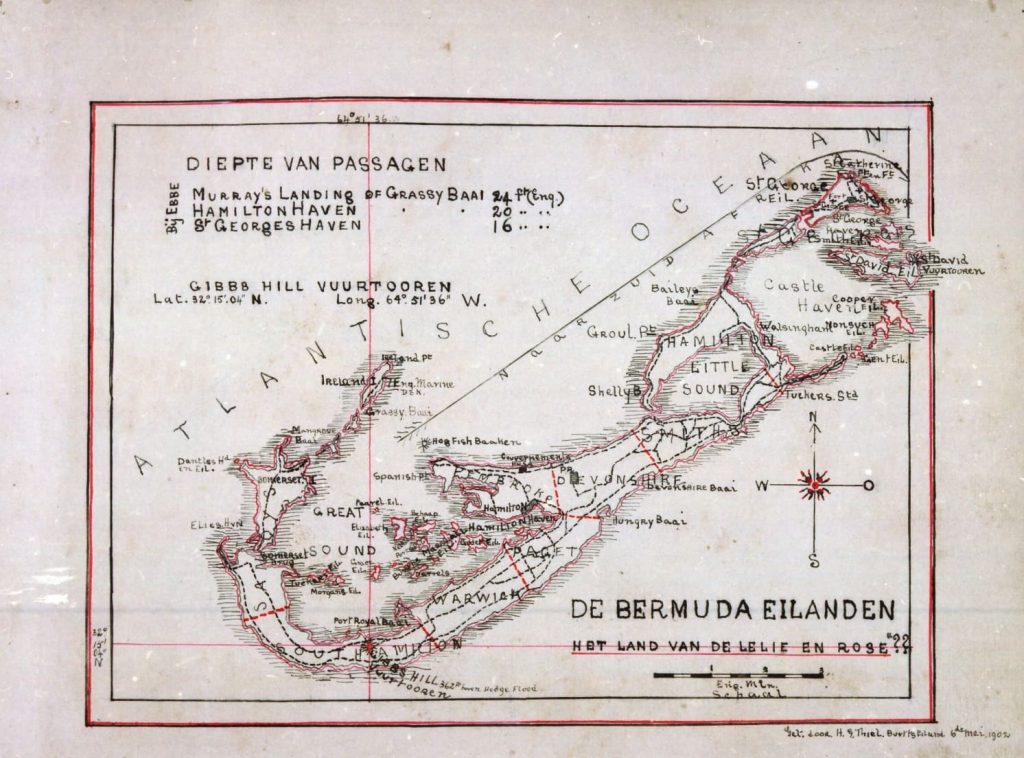
Some of the information included in this map is listed below.
- The depth of passages at ebbtide for three landing sites:
-
- Murray’s Landing of Grassy Baai 24 ft (Eng)
- Hamilton Haven 20 ft (Eng)
- St Georges Haven 16 ft (Eng)
- The exact position of Gibbs Hill Vuurtoren (Lighthouse)
-
- 32 degrees 15 minutes 04 seconds N.
- 64 degrees 51 minutes 36 seconds W.
The Gibbs Hill lighthouse is situated in the southernmost part of the archipelago. Its exact position is at the cross-point of horizontal and vertical red lines across the map. The position and name of the St. David Vuurtoren (Lighthouse) in the northern part are also entered.
- The names of several parishes on the main island, specifically Hamilton, Smith, Devonshire, Paget and Warwick.
- Three bodies of water between the islands: the Great Sound, where the small islands were situated and where the Boer POWs were incarcerated; the Little Sound, which is connected to the north to the Great Sound; and Castle Haven (harbour), a natural harbour located in the northeast of Bermuda.
- Five bays around the outer perimeter of the island group: Devonshire Baai (Bay) and Hungry Baai (Bay) on the eastern side; Mangrove Baai and Grassy Baai on the western side; and Port Royal Baai on the southern end of the Great Sound.
- The small barren islands in the Great Sound to which Hermann Thiel refers in his diaries and which are identifiable on the map are Morgans, Burtts, Darrels, Tuckers, and Ports Island. Several other islands in the Great Sound visible on the map are Marshall, Godel, Grace, Elizabeth, Schaap and Parel islands. Several other islands in other areas in Bermuda are discernible on the map. They include St David Island where letters were sent addressed to H.G. Thiel although no evidence exists that he ever stayed there.
- The bottom right corner of the map has a compass indicating the wind directions and a scale giving the length in 1, 2, and 3 English miles.