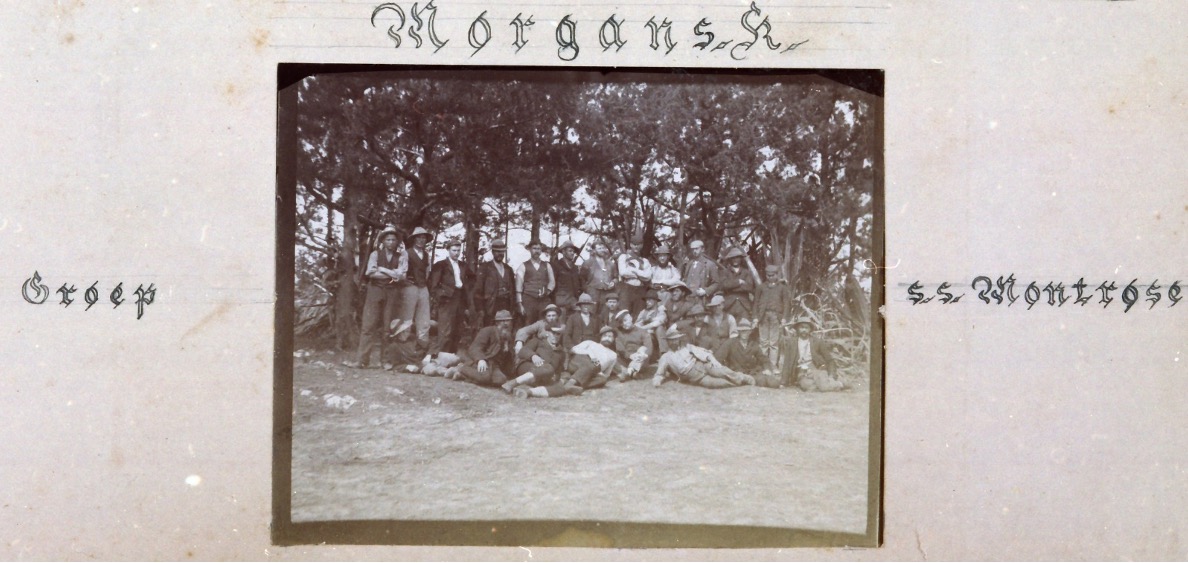
Hermann Gustav Thiel’s record of the voyage of the SS Montrose carrying 932 Boer POW’s to Bermuda during the Anglo-Boer War.
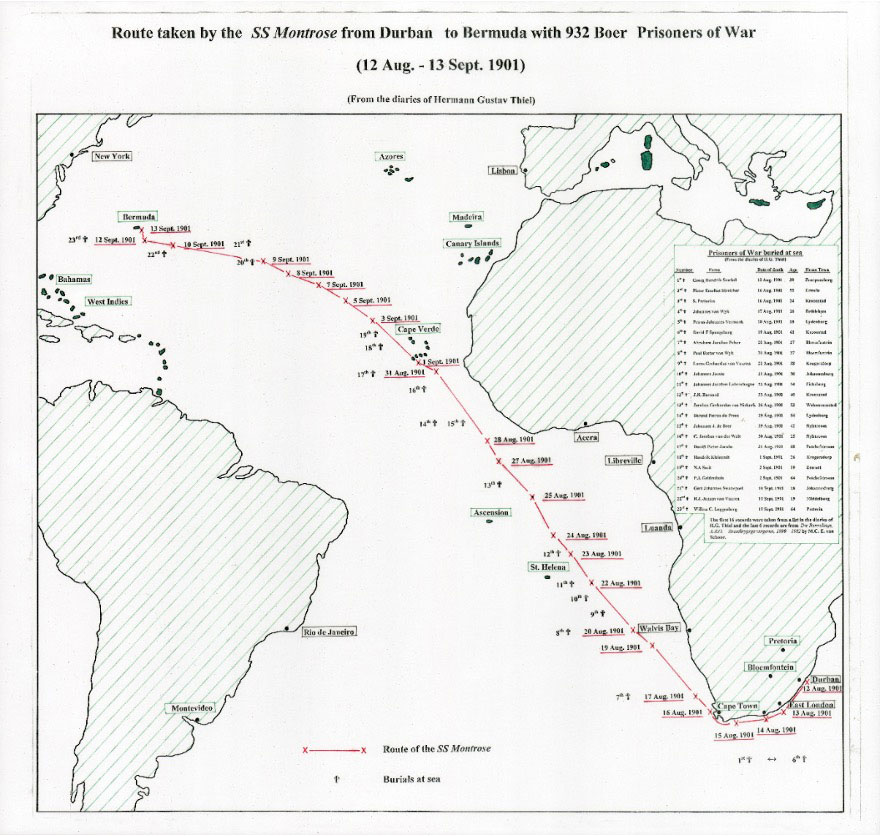
An example of the meticulous records Hermann Gustav Thiel (1878 – 1948) kept in his diaries of his experiences during the Anglo-Boer War (1899 – 1902) is the information he recorded on the voyage of the SS Montrose from Durban to Bermuda during August and September 1901. Not only did he describe the conditions under which the prisoners had to survive but he managed to record the exact daily position of the ship as well as the positions where 23 prisoners died and were buried at sea. This enabled us to prepare the map above of the route of the Monrose from Durban to Bermuda.
Towards the end of the Anglo-Boer War (1899 – 1902) the British government decided not to keep Boer prisoners in South Africa but to send them to various outposts of the British Empire such as India, Ceylon, St. Helena, and Bermuda as well as to Portugal. When the war ended in 1902 there were about 25 000 prisoners in these places. Six shipments of 4653 prisoners were sent to Bermuda of which 932 including Hermann Thiel travelled on the first voyage of the SS Montrose. This voyage was particularly hazardous as 23 POW’S passed away on route and were buried at sea causing this fourth transport to Bermuda to be referred to as the “Morte Rose” as described by Colin Benbow in “Boer Prisoners of War in Bermuda”
The names, age, origins and date of death of the 23 victims are summarized below. Positions where the were buried at sea are shown in the map above.
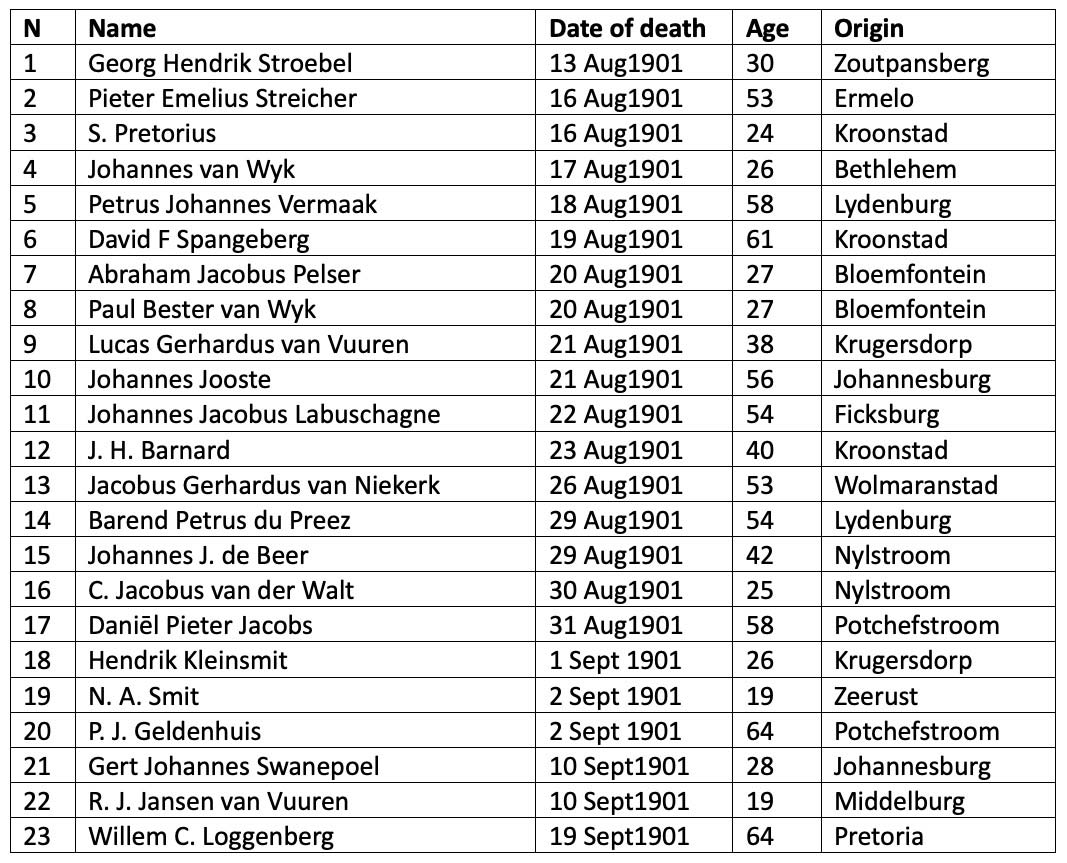
The first 16 records were taken from a list in the diaries of H.G. Thiel and the last 6 records are from Die Bannelinge, A.B.O. Boerekrygsgevangenes,1899 – 1902 by M.C.E. van Schoor.
Selected information recorded by Hermann Gustav Thiel during his transfer from Pretoria to Bermuda.
On 3 July 1901 Hermann Thiel was transported by train together with other Prisoners of War from Pretoria to Ladysmith in Natal where they waited from 7 July 1901 until 1 August 1901 for their transfer to Pieter Maritzburg. On 3 August 1901 they were taken to Durban and went directly to the harbour and were taken in a small steamboat to the transport ship, the SS Monrose. They were lifted in a huge basket, 8 prisoners at a time, onto the huge ship which was used to transport livestock before the war.
Hermann Thiel mentioned that the prisoners were cordially received by Captain Skipwith. The SS Montrose was hastily converted when the war started from a carrier of livestock to being able to transport troops and prisoners. He mentions that the living quarters were extremely uncomfortable as they were crammed into small spaces, 319 men in one chamber, with metal floors and very little ventilation. These conditions as well as the fact that most of the prisoners suffered from sea sickness caused severe cases of diarrhoea and pneumonia which were the main causes of the 23 deaths on the voyage.
The SS Montrose left Durban harbour on 12 August on the month-long voyage to Bermuda. In his diary Hermann Thiel made daily entries of their position as well as the weather condition and the places they passed such as Cape Town (16 August), St. Helena (22 August), The Equator (26 August), St. Jago Island (1 September), St. Vincent Island (2 September) to reach their destination, Bermuda, on 13 September 1901.
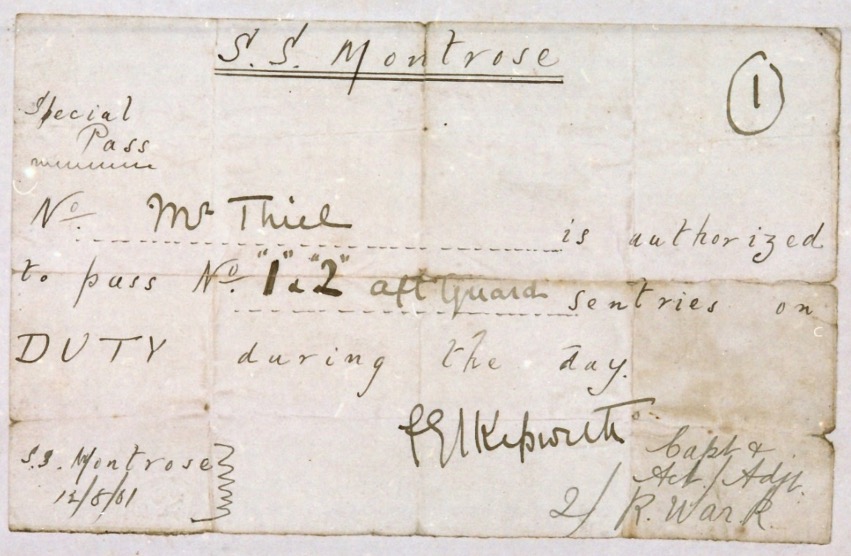
In his diary Hermann Thiel entered a lot of detail on events, living conditions, the weather, the food as well as the treatment of the prisoners on board. For the purpose of this entry, we want to include the only two documents he preserved from the voyage.
The first was a Special Pass for “Mr Thiel” issued before they left Durban Harbour, authorizing him to pass the Aft Guard Sentries during the day. It was signed on 12 August 1901 by Captain Kipwith indicating the trust the officers placed in him. He was only 23 years old at the time but was fluent in German, Dutch, Afrikaans and English and was well trusted by both his fellow prisoners and the British officers.
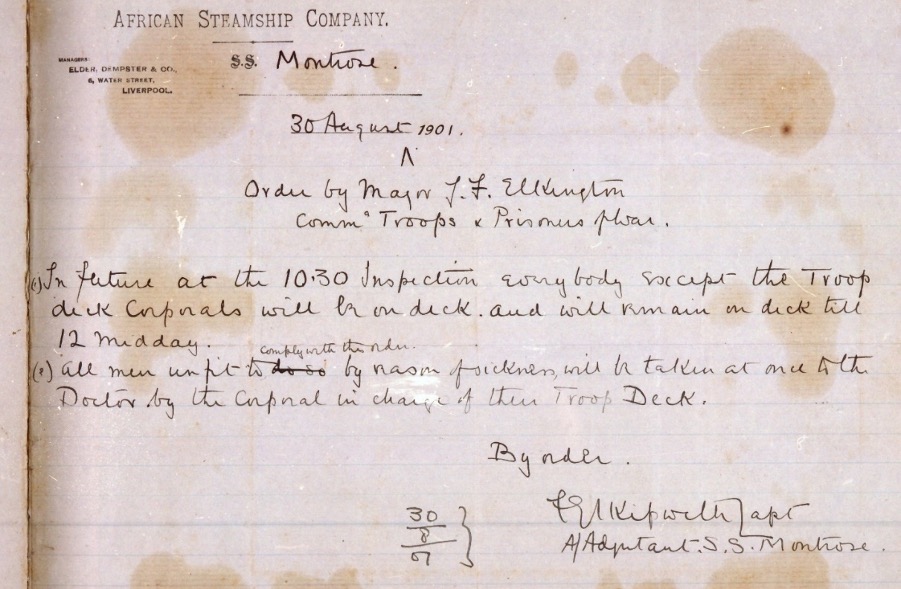
The second item was an Order on the letterhead of the AFRICAN STEAMSHIP COMPANY Issued on 30 August 1901 by Major J F Elkington that all prisoners should report on deck at 10.30 and should remain on deck until 12 midday while those not able to comply should be taken at once at once to the Doctor by the Corporal in charge of the Troop Deck.
A photo relevant to the fateful first trip of the SS Montrose to Bermuda with Boer Prisoners of War was included in the Memorial Album of Hermann Thiel’s participation in the war.
The photo includes prisoners from this voyage of the SS Montrose that ended up on Morgans Island, one of several little islands used in the Bermuda Archipelago during the war. Hermann Thiel stand in the centre of the back row.